
PSLE Prep 1
Primary 6 Science
Created by Miss Clarissa Ng · www.clartutors.com
Name: Class: Primary ___ Date: Marks:
Instructions
1. Do not open this paper until you are told to do so.
2. Total time for Booklet A and Booklet B: 1 h 45 min.
3. Booklet A has 30 questions. Each question carries 2 marks (60 marks). Circle the letter of the one best answer on this paper.
4. Booklet B has 11 questions worth 40 marks in total. Answer in the space provided, and write in complete sentences whenever a reason or an explanation is asked for.
5. The marks for each part are shown in brackets. You may use a pencil.
Booklet A — Multiple Choice Questions (30 questions · 2 marks each · 60 marks)
1.
Part S is the large intestine of the human body system.
Which process takes place mainly in part S?
Which process takes place mainly in part S?
A. Digestion of food
B. Absorption of food
C. Digestion of water
D. Absorption of water
2.
| Fruit | What the fruit is like |
|---|---|
| P | many seeds, sweet and juicy |
| Q | one seed, light and flat |
| R | five seeds, covered with hooks |
| S | a few seeds, rough skin |
A. Fruit P is dispersed by wind because it has many seeds.
B. Fruit Q is dispersed by wind because it is light and flat.
C. Fruit R is dispersed by water because it has hooks.
D. Fruit S is dispersed by animals because it has a rough skin.
3.
The young of a shield bug looks like the adult but has no wings.
Which of the following correctly describes the insect?
Which of the following correctly describes the insect?
A. It lays its eggs one at a time.
B. It lays its eggs in water.
C. It has a three-stage life cycle.
D. It has a four-stage life cycle.
4.
Yeast is a living thing used in baking. It feeds on the sugar in the dough and gives out carbon dioxide gas, which makes the dough rise.
Which group of living things does yeast belong to?
Which group of living things does yeast belong to?
A. Fungi
B. Bacteria
C. Plants
D. Animals
5.
The diagrams show the same community before and after owls came to live in it. The owls hunt the mice.
Which population would decrease after the owls have lived there for a period of time?
Which population would decrease after the owls have lived there for a period of time?
A. Eagle
B. Frog
C. Grasshopper
D. Mouse
6.
A leaf seen under a microscope: the tiny openings on its surface are open.
Which of the following is correct?
Which of the following is correct?
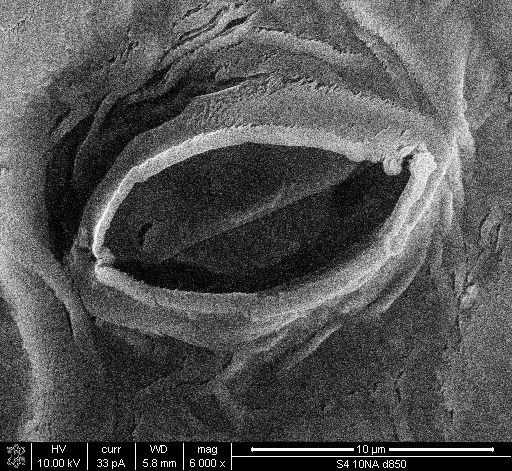
a leaf seen under a microscope: the tiny openings on its surface
Photo: Charles Tschirhart · Wikimedia Commons · CC BY-SA 3.0
A. The plant is in the light and the openings open to trap sunlight.
B. The plant is in the light and the openings open to take in carbon dioxide.
C. The plant is in darkness and the openings open to give out oxygen.
D. The plant is in darkness and the openings open to take in carbon dioxide.
7.
The diagram shows four blood vessels, A, B, C and D. The arrows show the direction in which blood flows.
Which graph best shows the amount of oxygen in the blood taken from each vessel? (A, B, C and D along the horizontal axis)
Which graph best shows the amount of oxygen in the blood taken from each vessel? (A, B, C and D along the horizontal axis)
A.
B.
C.
D.
8.
A fruit grower wants to produce new plants that bear big and sweet fruit. He has four flowers.
Which two flowers should he use?
| Flower | The fruit it bears |
|---|---|
| A | big and tasteless |
| B | small and tasteless |
| C | small and sweet |
| D | small and tasteless |
A. Flowers A and B
B. Flowers A and C
C. Flowers B and C
D. Flowers C and D
9.
Two different populations, X and Y, live together in the same habitat.
Which of the following is not a possible reason for this?
Which of the following is not a possible reason for this?
A. X and Y protect each other from predators.
B. X reproduces with Y.
C. X depends on Y for food.
D. X provides shelter for Y.
10.
Ali wants to find out whether seeds need oxygen and water to germinate. He sets up three test tubes, each with a seed on some cotton wool, and keeps them at room temperature.
Which of the following shows what happened to his seeds?
Which of the following shows what happened to his seeds?
| Test tube | The seed | The cotton wool | Gas in the tube |
|---|---|---|---|
| P | soaked | moist | air |
| Q | soaked | moist | carbon dioxide |
| R | not soaked | dry | air |
A. P germinated, Q did not germinate, R did not germinate
B. P germinated, Q germinated, R did not germinate
C. P did not germinate, Q did not germinate, R did not germinate
D. P germinated, Q did not germinate, R germinated
11.
The diagram shows an animal and a plant taking in and giving off gases.
Which statement is true?
Which statement is true?
A. The plant takes in oxygen both in the day and at night.
B. The plant takes in oxygen only at night.
C. The plant takes in carbon dioxide only at night.
D. The plant gives out carbon dioxide only when there is light.
12.
The chart shows the reproductive parts of a flower.
What do X and Y represent?
What do X and Y represent?
A. X: stamen, Y: pistil
B. X: pistil, Y: stamen
C. X: anther, Y: ovary
D. X: sepal, Y: petal
13.
The diagram shows the food web of a community. The number of squirrels in this community decreased suddenly.
Which is the most likely reason?
Which is the most likely reason?
A. The number of snakes increased.
B. The number of nut trees increased.
C. The number of caterpillars decreased.
D. The number of small birds decreased.
14.
A set-up is used to compare the rate of photosynthesis. Oxygen made by the pondweed is collected using a tube. In 5 minutes, 15 cm3 of oxygen was collected.
The lamp is then moved further away from the plant. What would happen in the next 5 minutes?
The lamp is then moved further away from the plant. What would happen in the next 5 minutes?
A. More than 15 cm3 of oxygen would be collected.
B. Less than 15 cm3 of oxygen would be collected.
C. No oxygen would be collected at all.
D. Exactly 15 cm3 of oxygen would be collected again.
15.
A farm is beside a river. Whenever the farmer adds fertiliser to his crops, some of it is washed into the river at S.
What is likely to happen to the living things in the river?
What is likely to happen to the living things in the river?
A. The algae grow faster, so the fish have more food and increase.
B. The algae grow faster; when they die, bacteria multiply and use up the oxygen, so the fish die.
C. The fertiliser poisons the algae, so the fish have no food and die.
D. The fertiliser does not affect the river at all.
16.
Rina hung a towel and a silk scarf over a metal bar. She could pull the silk scarf off with a smaller force than the towel.
Why?
Why?
A. There was less frictional force between the silk scarf and the bar.
B. There was more frictional force between the silk scarf and the bar.
C. There was less gravitational force acting on the silk scarf.
D. There was more gravitational force acting on the silk scarf.
17.
Xavier wound a coil of wire round an iron nail and joined the ends of the wire to a cell through a switch. His electromagnet could attract only one steel clip. He left the switch closed for a whole day, and the next day it could not attract even that clip.
What should Xavier do so that the electromagnet attracts more than one steel clip?
What should Xavier do so that the electromagnet attracts more than one steel clip?
A. Leave the switch on for one more day.
B. Replace the iron nail with a longer one.
C. Use a thicker iron nail.
D. Increase the number of coils of wire around the nail.
18.
A ceiling lamp has three bulbs, X, Y and Z. When bulb Y blew, the other two bulbs continued to light up.
Which statement must be true?
Which statement must be true?
A. The three bulbs are connected in series.
B. The three bulbs are connected in parallel.
C. X and Y are in series and Z is in parallel.
D. The bulbs are connected to two cells in series.
19.
Salim poured water into four sections of an ice tray and put the tray in the freezer. One section was round, one was square, one was triangular and one was long and thin. When the water froze, he had four pieces of ice, each with the shape of the section it was in.
Why?
Why?
A. Ice does not have a definite shape.
B. Ice does not have a definite volume.
C. Water does not have a definite shape.
D. Water does not have a definite volume.
20.
A paratrooper jumps from an aeroplane and falls slowly to the ground.
Which of the statements is/are true?
A: Gravitational force stops the paratrooper from falling too quickly.
B: Gravitational force is the only force acting on him while he is falling.
C: Gravitational force is still acting on him even when he is standing on the ground.
Which of the statements is/are true?
A: Gravitational force stops the paratrooper from falling too quickly.
B: Gravitational force is the only force acting on him while he is falling.
C: Gravitational force is still acting on him even when he is standing on the ground.
A. B only
B. C only
C. A and B only
D. A, B and C
21.
In four experiments, water in a beaker was heated for ten minutes and the water vapour given off was led through a glass tube into a second beaker, where it was collected. The table shows the conditions used in each experiment.
In which experiment was the most water collected in the second beaker?
In which experiment was the most water collected in the second beaker?
| Experiment | The water was heated to | A towel was wrapped round the glass tube |
|---|---|---|
| A | 90 °C | warm and dry |
| B | 90 °C | cold and wet |
| C | 100 °C | warm and dry |
| D | 100 °C | cold and wet |
A. A
B. B
C. C
D. D
22.
Crushed ice was heated and its temperature was taken every minute for 12 minutes. The graph shows the results.
What is happening to the ice between the 2nd and the 6th minute?
What is happening to the ice between the 2nd and the 6th minute?
A. The ice is melting, and the temperature stays at 0 °C because the heat is used to melt the ice.
B. The ice is not being heated, so its temperature does not change.
C. The ice is boiling at 0 °C.
D. The temperature does not change because no heat is taken in.
23.
Cells and bulbs of the same type are used in the four circuits shown.
In which circuit does the bulb shine the brightest?
In which circuit does the bulb shine the brightest?
A. Circuit A
B. Circuit B
C. Circuit C
D. Circuit D
24.
Magnet A was pushed slowly towards magnet B on a table. Before magnet A could touch it, magnet B slid away.
Which statement is true?
Which statement is true?
A. The two ends facing each other are like poles, so they repel.
B. The two ends facing each other are unlike poles, so they repel.
C. Magnet B was pushed away by the wind.
D. Magnetic force acts only when the two magnets touch.
25.
Ganesh has three metal rods of different materials. He wants to find out how easily each rod can be bent when heated.
Which of the following must he keep the same?
A: the temperature of the rods B: the length of the rods C: the force needed to bend each rod
Which of the following must he keep the same?
A: the temperature of the rods B: the length of the rods C: the force needed to bend each rod
A. A only
B. B only
C. A and B only
D. A, B and C
26.
A circuit has two cells and two bulbs in series.
Which of the four circuits shown has the dimmest bulb(s)?
Which of the four circuits shown has the dimmest bulb(s)?
A. Circuit A
B. Circuit B
C. Circuit C
D. Circuit D
27.
A pupil hangs 50 g weights on a spring, one at a time, and measures how far the spring stretches. His results are in the table.
He then hangs five of the same weights on the spring. The spring is not stretched beyond its limit.
What is the extension of the spring?
He then hangs five of the same weights on the spring. The spring is not stretched beyond its limit.
What is the extension of the spring?
| Number of 50 g weights | Extension of the spring |
|---|---|
| 1 | 2 cm |
| 2 | 4 cm |
| 3 | 6 cm |
| 4 | 8 cm |
A. 8 cm
B. 9 cm
C. 10 cm
D. 12 cm
28.
Thomas rode his skateboard up the same slope twice. Both times he started from the same point at the bottom of the slope and rolled straight up it without pushing. The first time he slowed down to a stop part-way up and rolled back down. The second time he reached a point higher up the slope before he stopped.
Why was he able to go higher on the second try?
Why was he able to go higher on the second try?
A. He had more kinetic energy at the bottom of the slope.
B. He had more gravitational potential energy at the top of the slope.
C. The slope was steeper the second time.
D. There was no friction acting on him the second time.
29.
A pupil tested four materials by putting a drop of water on each one. The table shows what he saw.
A raincoat must keep the rain out. Which material is the most suitable to make a raincoat?
A raincoat must keep the rain out. Which material is the most suitable to make a raincoat?
| Material | What happened when a drop of water was put on it |
|---|---|
| cotton | the water spread out and soaked in at once |
| paper | the water soaked in slowly |
| plastic sheet | the water stayed as a drop on the surface |
| sponge | the water soaked in quickly |
A. Cotton
B. Paper
C. Plastic sheet
D. Sponge
30.
A torch shines on a ball, and a shadow of the ball is formed on a screen behind it.
The ball is now moved nearer to the torch, and the screen is not moved.
What happens to the shadow on the screen?
The ball is now moved nearer to the torch, and the screen is not moved.
What happens to the shadow on the screen?
A. It becomes bigger.
B. It becomes smaller.
C. It stays the same size.
D. It disappears completely.
Booklet B — Open-Ended Questions (11 questions · 40 marks)
31.
Lisa wants to find out how the amount of water given to a plant affects its growth. She planted three identical plants, P, Q and R, in identical pots of soil. She gave each plant a different amount of water every day for ten days, and measured the height of each plant on the last day.
(a)
State the variable that Lisa changed. [1]
(b)
State two variables that Lisa must keep the same to make her test fair. [2]
(c)
Why did Lisa measure the height of the plants after the same number of days? [1]
32.
Many trees were cut down on a piece of land. The numbers of three kinds of animals, A, B and C, were counted before the trees were cut and again one year later.
| Animal | Number before | Number one year later |
|---|---|---|
| A | 120 | 20 |
| B | 60 | 55 |
| C | 30 | 90 |
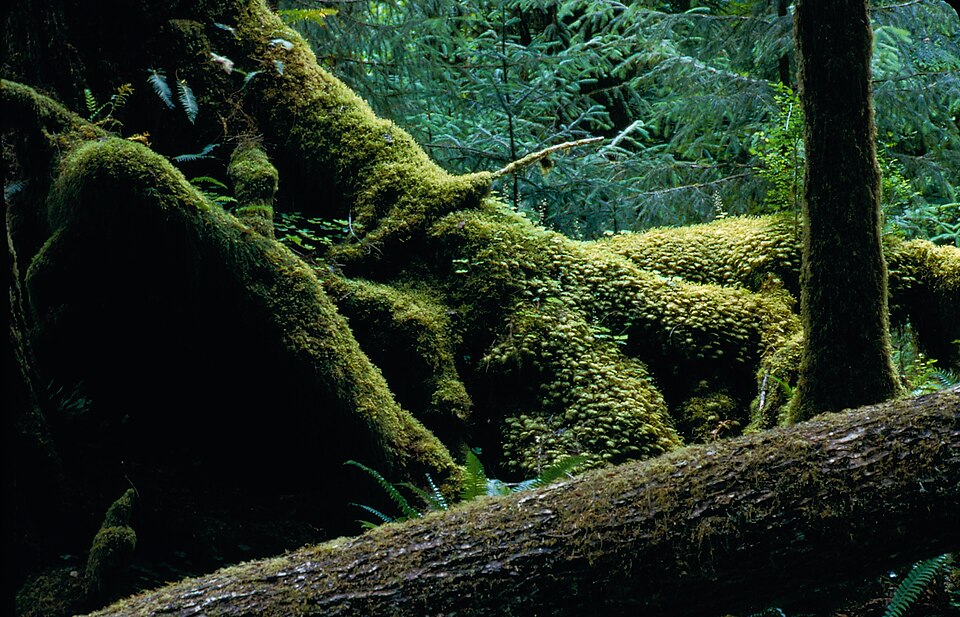
Before — covered with trees
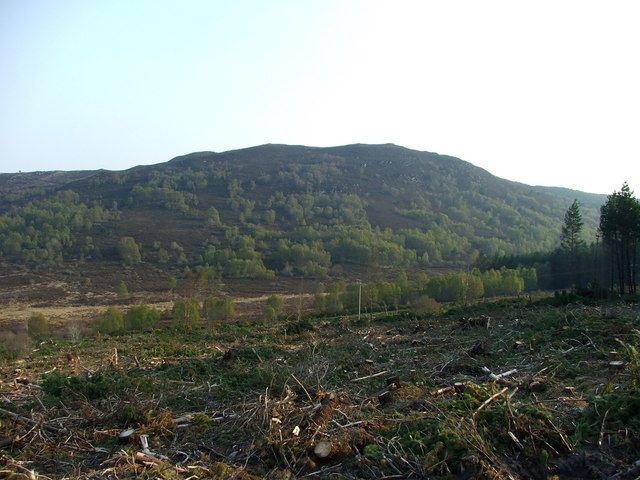
After — the trees have been cut down
Photos: Olympic National Park, David Maclennan · Wikimedia Commons · CC BY-SA 2.0 and Public domain
(a)
Describe the change in the number of animals A. [1]
(b)
Explain why the number of animals C increased after the trees were cut down. [2]
(c)
Give one reason why the numbers counted may not show exactly how many animals were on the land. [1]
33.
A small bird's nest with eggs in it — one egg is not the bird's own.
The cuckoo's egg looks like the bird's own eggs and hatches first, then the young cuckoo pushes the other eggs and young birds out of the nest.
The cuckoo's egg looks like the bird's own eggs and hatches first, then the young cuckoo pushes the other eggs and young birds out of the nest.
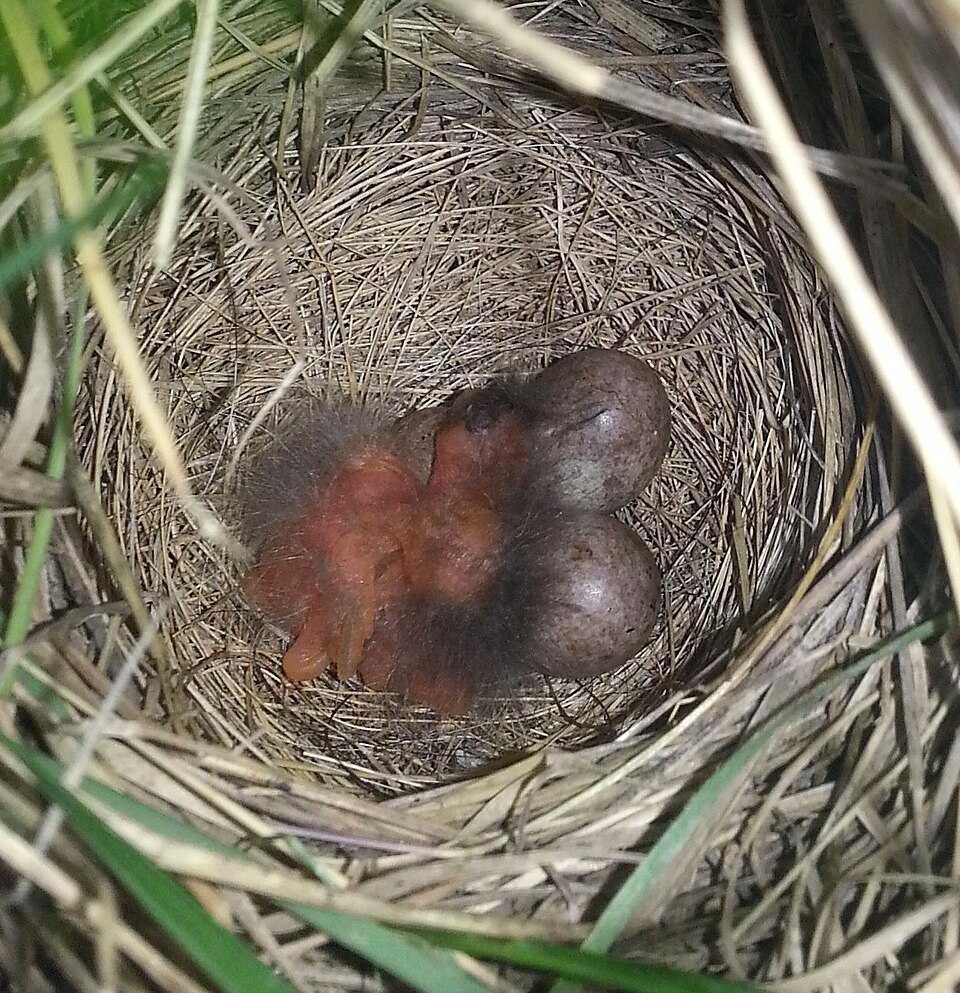
a small bird's nest with eggs in it — one egg is not the bird's own
Photo: Kati Fleming · Wikimedia Commons · CC BY-SA 3.0
(a)
Why does the robin not notice that there is a strange egg in its nest? [1]
(b)
Why is it an advantage to the young cuckoo that its egg hatches before the robin's eggs? [1]
(c)
How does laying its egg in another bird's nest help the cuckoo to survive? [1]
34.
A plant was placed on a windowsill. After a few days, the plant was seen to be bending towards the window, as shown.
(a)
Name this response of the plant to light. [1]
(b)
The plant is now turned around so that the light comes from the other side. What would you expect to see after a few more days? [1]
(c)
Explain why bending towards the light helps the plant to stay alive. [2]
35.
A parent plant drops its seeds on the ground. Later, young plants of the same kind are found at different distances from the parent plant and in different directions from it.
(a)
Name the process by which the seeds were spread away from the parent plant. [1]
(b)
Explain how the seeds could end up at different distances and in different directions from the parent plant. [2]
36.
Meng bought a tub of ice cream and carried it home in a cooler bag. The bag is made of thick material and its inside is lined with shiny foil.
(a)
How does the cooler bag keep the ice cream from melting quickly? [1]
(b)
Explain how the shiny foil lining helps. [2]
37.
There are three boxes, A, B and C, on the floor. They are the same size and shape but have different masses.
(a)
Which box was the most difficult to lift off the floor? Explain your answer. [2]
(b)
Samuel holds box A in the air without moving it. Explain why he still has to use a force even though the box is not moving. [2]
38.
The melting points of three types of matter, P, Q and R, are shown in the table.
| Type of matter | Melting point |
|---|---|
| P | 0 °C |
| Q | 80 °C |
| R | −40 °C |
(a)
Which type of matter most possibly has a boiling point of 100 °C? Explain your answer. [2]
(b)
P, Q and R were mixed together at 30 °C and the mixture was poured through a sieve. Which type of matter would be left in the sieve? [1]
(c)
Name a method that can be used to separate the two liquids, P and R, from each other. [1]
39.
Wei Li put pieces of paper between a lamp and a light sensor inside a cardboard box (opaque, so no light gets in). He used two kinds of paper, E and F, which are of different thicknesses. He found that he needed four pieces of paper E, but six pieces of paper F, to stop the sensor from detecting any light.
(a)
Which paper lets less light through, E or F? Explain your answer. [1]
(b)
Why did the box have to be opaque? [1]
(c)
State one variable Wei Li must keep the same in his test. [1]
40.
Magnet A was pushed slowly towards magnet B, which was lying on a table. Magnet B started to move before the two magnets touched. The activity was then repeated on table Y, which has a smoother surface, and the table below shows how far apart the magnets were when magnet B started to move.
| Table | Distance between the magnets when B started to move |
|---|---|
| X | 2.0 cm |
| Y | 3.5 cm |
(a)
Explain why magnet B moved even though magnet A did not touch it. [2]
(b)
Explain why magnet B started to move when the magnets were further apart on table Y than on table X. [2]
41.
Ali sets up the circuit shown, which has one cell and two bulbs, X and Y.
(a)
Can Ali switch off only one of the bulbs? Explain your answer. [2]
(b)
Ali also has a second cell and a third bulb of the same type. Describe how he should set up a fair test to find out whether the number of cells affects how brightly a bulb shines. [2]
About the pictures. The photographs in this paper come from Wikimedia Commons and are used under the licences credited under each one (licence terms: creativecommons.org/licenses/by/2.0 · creativecommons.org/licenses/by-sa/2.0 · creativecommons.org/licenses/by-sa/3.0). Every other figure — circuits, food webs, graphs, apparatus and charts — is drawn for this paper, because there is nothing to photograph.